You might want to stand up for this: “Sitting is the new smoking” says a recent study on the economic impact of reduced physical inactivity and sedentary behavior. Indeed, it’s well documented that we are, essentially, sitting far too much, and for far too long. The results of this have been shown to be negatively affecting our health, and waistlines.
Unfortunately, studies have determined that exercise, while beneficial, does not counteract the effects of prolonged sitting.
An interest in improved health and wellness, by both administrators and staff, has prompted many offices to embrace modified workspaces. Those with physical ailments, such as back issues, are also seeking non-traditional work environments, in hopes of providing relief.
According to The National Institute for Occupational Safety and Health, “a well-designed office allows each employee to work comfortably without needing to over-reach, sit, or stand too long, or use awkward postures (correct ergonomic design). Sometimes, equipment or furniture changes are the best solution to allow employees to work comfortably.”
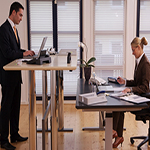
One example of such equipment is standing desks. Under the umbrella of standing desks are desktop attachments (that modify existing desks), sit-stand desks, and stand-only desks.
Advantages
One assumed advantage to standing desks is that they are better for your health. Some manufacturers and enthusiasts even claim you’ll burn calories and lose weight.
To date, there’s no body of research or scientific proof linking the use of standing desks to improved health or weight loss.
However, many users of standing desks find that they tend to move more as a result of already being in a standing position—from pacing to shifting weight from one foot to another. While that might not sound like much, a recent study found that “modest, achievable changes in movement behaviors can produce substantial and important improvements in health, and should be embraced.” Other studies concur that regular, low-intensity movements add up, and are beneficial to our health.
Ken Warren, managing partner of international law firm Gowlings’ Calgary, Alberta, offices, an award-winning office space, says an upcoming office move resulted in his firm looking at replacing furniture sets for both lawyers and staff.
“I don’t hesitate to dash out of my office to see someone down the hall as I’m already standing and am only a few quick steps from the door,” says Warren. “When you’re sitting, inertia tends to keep you sitting.”
So while standing desks haven’t been proven to positively affect health, the fact they may encourage more movement over the course of a day is a good thing.
With standing desks becoming more commonplace, the choice of models and styles has expanded significantly. What used to be a handful of options has now become dozens, meaning whatever your preferences, there’s likely something available.
Another advantage: Cost. Many available options means there is something out there to suit most budgets.
Disadvantages
At one time, cost was the biggest inhibitor to purchasing a standing desk but as the concept has become more widespread, so have the models and options, resulting in many different price points.
Those currently using standing desks report that their biggest challenge has been the transition from sitting to standing.
“It took a few weeks to become accustomed to standing,” says Warren. “I wouldn’t recommend that you go from sitting all day to standing all day overnight. Ease into it. If you’re used to sitting several hours each day, your feet will suffer for a while until you get accustomed to standing.”
For relief, a gel or anti-fatigue mat is recommended. Some users also find it more comfortable to work with no shoes, or change to more comfortable shoes. A foot rest can aid with shifting weight from one foot to another, while a stool provides additional support without sitting down fully.
And, just as sitting for prolonged periods isn’t ideal, neither is standing. This is a major disadvantage of a non-adjustable standing desk where the only option is to, well, stand. Additionally, many are of a fixed height, which may not work with your body type or height, resulting in poor ergonomics. A standing-only desk is also not conducive to office meetings, unless you have a separate table.
Another consideration is that some standing desk models have less desktop workspace and storage space. However, if you choose desktop attachments to convert your existing desk into a sit-stand workspace, or choose a standing desk with multi-level surfaces or accessories, this may be a non-issue.
What to look for
With the sheer variety of standing desks available, it can be overwhelming knowing what to look for. Here are some suggestions:
- Choose an adjustable model that allows the flexibility for both sitting and standing, to give staff the option for either. This also takes into account future staff that may use the same workspace.
- With adjustable models, consider a motorized rather than hand-cranked mechanism for adjusting height. The former is better at evenly distributing the weight of equipment.
- Whichever workspace you choose, ensure proper ergonomics for both standing and sitting positions. A workspace with at least two tiers, one for monitor and one for keyboard, may help.
- While not a feature, invest in recommended accessories, the most common being gel or anti-fatigue mats.
Where to start
Speak with your existing office-furniture supplier, who is likely already familiar with the many options available and can help guide you. Providing your budget up-front also ensures you’re shown only the options you can afford.
Consider your existing office space. As noted earlier, some standing desk models encompass an entirely new workspace, while some models are attachments that work with existing desks.
Include staff in the decision-making process. After all, they will be the ones using the equipment.
Will the offices of the future consist only of standing desks? That remains to be seen, but Warren thinks standing desks are far from a temporary fad. “Time will tell whether our habits change similarly over the coming decades, but I won’t be surprised to see standing desks offered more frequently by forward-thinking employers and demanded more by employees concerned about their wellness.”
| Related reading: | ||
 Redesign the office to keep up with industry and technology changes |
 Better productivity and a happier staff happen as ergonomics steps in |
 Clark Wilson’s branding by design |